The
history of Pune (a city in Maharashtra, India) begins in the 6th century, and is closely linked to the history of Shivaji, the founder of the Maratha empire, and to the Peshwa, the ministers of the Maratha empire and later the Maratha confederacy.
Early and Medieval:
Copper plates dated to 758 and 768 show that, by the 8th century, an agricultural settlement known as
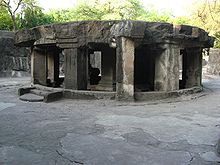
Punnaka existed where Pune is today. The plates indicate that this region was ruled by the Rashtrakutas. The Pataleshwar rock-cut temple complex was built during this era. The
Kasba peth in central Pune were constructed in the 5th century.
Pune was a part of Yadava Empire of Deogiri from the 9th century to 1327. It was later ruled by the Nizamshahi sultans, until it was annexed by the Mughal empire in the 17th century. In 1595, Maloji Bhosale was appointed the jagirdar of Pune and Supe by the Mughals
[1].
Maratha and Peshwa rule:
In 1625, Shahaji Bhonsle appointed Rango Bapuji Dhadphale as the administrator of Pune. He was one of the first major developers of the town, overseeing the construction of the Kasba, Somwar, Ravivar and Shaniwar Peths. Construction also began on the Lal Mahal palace, as Shahaji's son, Shivaji Bhonsle (later
Chattrapati Shivaji) was to move there with his mother Jijabai. The Lal Mahal was completed in 1640
[1]. Jijabai is said to have commissioned the building of the Kasba Ganapati temple herself. The Ganapati idol consecrated at this temple is regarded as the presiding deity (
gramadevata) of the city
[2].
From 1630 to 1647, Dadoji Kondev, Shivaji's childhood mentor and teacher, oversaw development and construction in the area. As a child, Shivaji is said to have commemorated agricultural activities personally by using specially made golden ploughs
[citation needed]. After Shivaji was crowned Chhatrapati (
King) in 1649, he oversaw further development in Pune, including the construction of the Guruwar, Somwar and Mangalwar peths. Before the rise of the Peshwe, five other peths were constructed: Shukrawar, Raviwar, Shaniwar, Bhavani, and Ghorpade Peth. Budhwar Peth was constructed in 1703 by the emperor Aurangzeb.
Baji Rao I became Peshwa of the Maratha empire, ruled by Chattrapati Shahuji, in 1720. By 1730, the palace of Shaniwarwada had been constructed on the banks of the Mutha river, ushering in the era of Peshwa control of the city. The patronage of the Peshwas resulted in the construction of many temples and bridges in the city, including the Parvati temple and the Ganesh, Sadashiv, Narayan, Rasta and Nana Peths.
The Peshwas fell into decline after their loss in the Third Battle of Panipat in 1761. In 1802, Pune was captured from the Peshwa by Yashwantrao Holkar in the Battle of Poona, directly precipitating the Second Anglo-Maratha War of 1803-05.
British Raj:
The Third Anglo-Maratha War broke out between the Marathas and the British in 1817. The Peshwas were defeated at the Battle of Khadki (then transcribed
Kirkee) near Pune, and the city was seized. It was placed under the administration of the Bombay Presidency, and the British built a large military cantonment to the east of the city (now used by the Indian Army). The Pune Municipality was established in 1858. The British also oversaw the construction of Ganj Peth (renamed to Mahatma Phule Peth after 1947) and Navi Peth. Pune was at one time the "monsoon capital" of the Bombay Presidency.
Nanasaheb Peshwa, the adopted son of the last Peshwa Bajirao II, rose against British East India Company rule in 1856, as part of the Indian Mutiny. He was helped by Rani Lakshmibai of Jhansi and Tatya Tope. After the mutiny failed, the final remnants of the Maratha empire were annexed to British India.
1858-1947:
Pune was an important center for the social and religious reform movements that were sweeping the country. Many prominent reformers lived here, including Mahadev Govind Ranade, Ramakrishna Gopal Bhandarkar, Gopal Krishna Gokhale, Maharshi Vitthal Ramji Shinde and Jyotirao Phule. The most important political reformer of this era was Bal Gangadhar Tilak, who dominated the Indian political scene for six decades.
Pune is also associated with the struggle for Indian independence. Mohandas Gandhi was imprisoned at Yerwada jail several times, and placed under house arrest at the Aga Khan Palace in 1942-44, where both Kasturba Gandhi, his wife, and Mahadev Desai, his long-time aide and secretary, died.
After independence:
After Indian Independence, Pune saw a lot of development, such as the establishment of the National Defense Academy National Defense Academy at Khadakwasla, National Chemical Laboratory at Pashan. Pune also serves as the headquarters of the Southern Command of the Indian Army.
[3] Industrial developments started around 1950-60s in Hadapsar, Bhosari, Pimpri, and Parvati.
[4] Telco (now Tata Motors) started operations in 1961, which gave a huge boost to the automobile sector. Pune was referred at that time as “Pensioners’ Paradise” since many government officers, civil engineers, and Army personnel preferred to settle down in Pune after their retirement.
In July 1961, Panshet dam broke and its waters flooded the city, destroying most of the older sections, giving a chance for modern town planning concepts to be put into use. This unfortunate incident however led constructive developments in the city, and the economy of the city witnessed a boom in construction and manufacturing sectors. By 1966, the City had expanded in all directions.
[4]
After 1970, Pune emerged as the leading engineering city of the country with Telco, Bajaj, Kinetic, Bharat Forge, Alfa Laval, Atlas Copco, Sandvik and Thermax expanding their infrastructure. By this time the city had gained the reputation of being the ‘Oxford of the East’ due to a large number of educational institutes. In 1989, Dehu Road-Katraj bypass (Western bypass) was completed, reducing traffic congestion in the inner city. In 1990 Pune began to attract foreign capital, particularly in the information technology and engineering industries; new businesses like floriculture and food processing begin to take root in and around the city. In 1998, work on the six-lane Mumbai-Pune expressway began; a huge accomplishment for the country, the expressway was completed in 2001.
[5] In the three years before 2000 Pune saw huge development in the Information Technology sector, and IT Parks formed in Aundh, Hinjewadi and Nagar road. By 2005 Pune overtook both Mumbai and Chennai to have more than 2 Lakh (200,000) IT professionals.In 2006, PMC started BRT (Bus Rapid Transit System) project first among all Indian cities but due to narrow roads of the city it has not worked properly. However, PMC is working on glitches in this project and planning skywalks near BRT and other changes. The year 2008 saw huge development near the Chakan and Talegaon region as Multinational Corporations (MNCs) like General Motors, Volkswagen, and Fiat have set up facilities near Pune. Additionally, in 2008 the Commonwealth Youth Games took place in Pune, which encouraged additional development in the north-west region of the city and added a few Compressed Natural Gas (CNG) buses on Pune's road.
[6] The Pune Metropolitan Regional Development Authority (PMRDA)'s proposed initiatives will give a huge boost to the city’s infrastructure and include the development of systems for a metro (rapid-transit rail) and buses, plus effective water and garbage treatment facilities.